
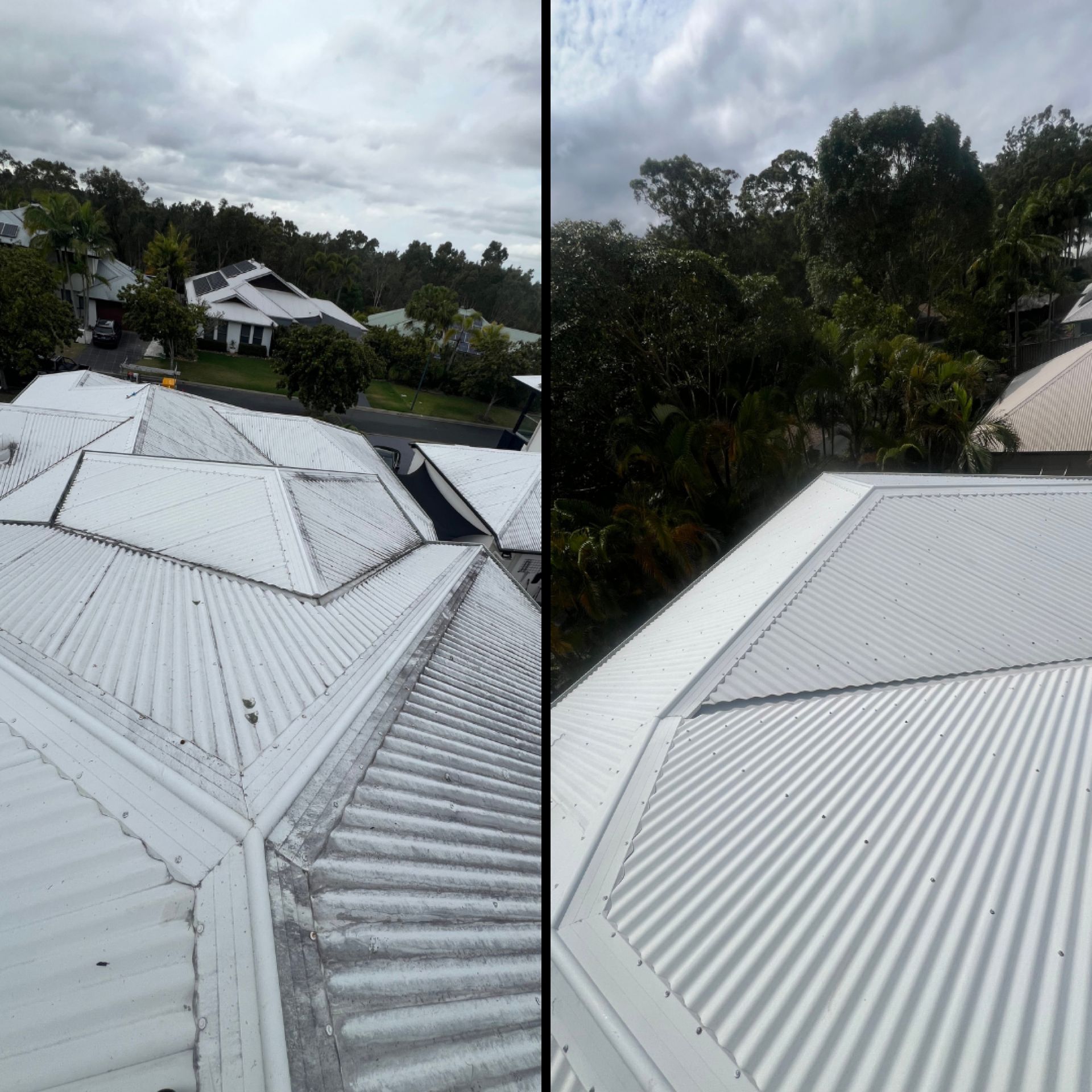
Heavily weathered double-storey white Colorbond house roof restored to clean original finish via a multi-pass soft wash process — chemical application, dwell time, and low-pressure rinse repeated 5–7 times across the surface to fully clear embedded oxidisation, mould, and biological staining. The result of doing the work properly rather than cutting it short at one pass.
Before & After
What We Did
Roof inspection & access setup
Inspected the Colorbond surface to confirm coating integrity, identified the most heavily contaminated sections, and set up safe access for double-storey roof work. Confirmed the underlying coating was sound — what looked like coating failure was contamination only.
Surrounds protection & initial rinse
Protected gutters, downpipes, surrounding garden, and adjacent roof sections from biocide drift. Performed an initial low-pressure rinse to clear loose debris and prepare the surface for the first chemical application.
Multi-pass chemical & rinse cycle (5–7 passes)
Applied specialised soft wash biocide solution at low pressure across the entire roof, allowed full dwell time for the chemistry to break down embedded contamination, then rinsed at controlled low pressure. This cycle was repeated 5–7 times across the roof. Heavy oxidisation and embedded biological growth on weathered Colorbond won't release in a single pass — single-pass cleans look acceptable from the ground but leave significant contamination embedded in the corrugation channels and surface pores. Multi-pass treatment is the difference between a cheap surface clean and a proper restoration.
Detail work on ridges & valleys
Worked the ridge sections and valleys with additional attention — these areas hold contamination longer than flat panels and benefit from extra dwell time and additional pass cycles to match the rest of the roof finish.
Final rinse & gutter clear
Final controlled low-pressure rinse across the entire surface to flush all dead organic matter, oxidisation residue, and biocide solution clear of the roof. Cleared the gutter line of the substantial debris flushed during the multi-pass process — multi-pass cleans produce significantly more gutter debris than single-pass jobs.
Final inspection
Walked the full roof to confirm uniform finish across all panels, ridges, and valleys, with the original white Colorbond colour fully revealed. No streaking, no missed sections, no remaining contamination.
The Result
The roof was restored from a heavily oxidised, mould-stained surface to clean original white Colorbond — fully matching the appearance of a much newer roof. The multi-pass approach delivered a uniform, deep clean that single-pass methods would have left incomplete, particularly in the corrugation channels and ridge sections. No painting or replacement required.
A properly executed multi-pass soft wash on Colorbond typically delivers 18–30 months before mould and oxidisation begin to return — significantly longer than single-pass cleans, which often need redoing inside 12 months because the underlying contamination wasn't fully cleared. Coastal properties like Kingscliff face accelerated regrowth from salt air and humidity, making the depth of the initial clean even more important.
Suitable For
Colorbond and powder-coated metal roofing should always be cleaned with soft wash plus low-pressure rinse — never high pressure, which chips the coating. Heavy weathering or coastal-climate contamination requires multiple passes to fully clear embedded oxidisation and biological growth. A single-pass clean may look fine on the day but will need redoing far sooner — the extra time spent on proper multi-pass treatment is what delivers a result that lasts.
This double-storey Kingscliff home had a white Colorbond roof that had become heavily contaminated over time — oxidisation staining, biological growth embedded in the corrugation channels, and the kind of overall dull, weathered appearance that makes a roof read as end-of-life from the ground. The before image shows the condition clearly: mottled, stained panels with the original white finish almost completely obscured. Replacement or repaint quotes were the direction the owners were heading.
The underlying coating was still sound. What looked like coating failure was contamination — and the right cleaning process would reveal the original Colorbond beneath it. The issue with Colorbond at this level of weathering is that a single-pass soft wash won’t fully clear embedded oxidisation and biological growth from the corrugation channels and surface pores. Single-pass cleans look adequate from the ground on the day but leave significant contamination embedded in the surface, which means regrowth returns well inside 12 months and the job needs repeating. That’s not a restoration — it’s a temporary visual fix.
The correct approach for heavily weathered Colorbond is a multi-pass cycle: biocide application, full dwell time, low-pressure rinse — repeated 5–7 times across the roof surface. Each pass draws more embedded contamination out than the last. The difference between a single-pass and a 5-pass clean on a roof like this is visible in the result: a properly uniform finish across every panel and channel rather than a clean-looking surface with contamination still sitting in the corrugations. It takes significantly longer, but the result holds for 18–30 months rather than needing to be redone inside a year.
The gutter clear at the end is non-negotiable on a multi-pass job — the volume of flushed debris is substantial and will cause blockages if left in place. The full job was delivered as a proper restoration, not a surface clean, and the result is a roof that matches the appearance of a much newer installation with no painting or replacement required.
More Like This

Acit Commercial Facility Full External Clean — 3000m² in One Day
Logan
Single-day commercial external cleaning project for Acit ("We Speak Food") — a 3000m² facility cleaned across one working day. Full soft wash and pressure wash of all external walls, breeze block sections, render, soffits, eaves, and roller doors to remove heavy mould and organic contamination. Coordinated team delivery at scale, with the food industry's particular hygiene and presentation standards in mind.
View project →
Balcony Tile Pressure Clean — Gold Coast
Gold Coast
Heavily stained white tile balcony in a Gold Coast residential property restored to clean original finish via pressure cleaning. Tiles, grout lines, glass balustrade, and white framing all returned to a clean, even appearance ready for use.
View project →
Byron Bay Mansion — Synthetic Turf Maintenance Package (6-Monthly)
Byron Bay
Ongoing 6-monthly maintenance package at a luxury Byron Bay mansion — synthetic turf restoration including debris and algae removal, pressure washing, fresh sand topup, and power brooming to maintain the turf in show-condition year-round. Plus surrounding hardscape pressure washing across stone retaining walls and feature elements. The kind of recurring maintenance contract that keeps a high-end property at presentation standard between major restoration cycles.
View project →