
Commercial Pebblecrete Pressure Wash — Physio Practice (500m², Weekend Delivery)
Approximately 500m² of pebblecrete pressure cleaned at a commercial physio practice — delivered across a weekend to avoid disturbing the working week, with slip-hazard reduction as a primary driver. Large-area commercial cleaning scheduled around the client's operating hours, with full PPE and safe equipment use throughout.
Before & After
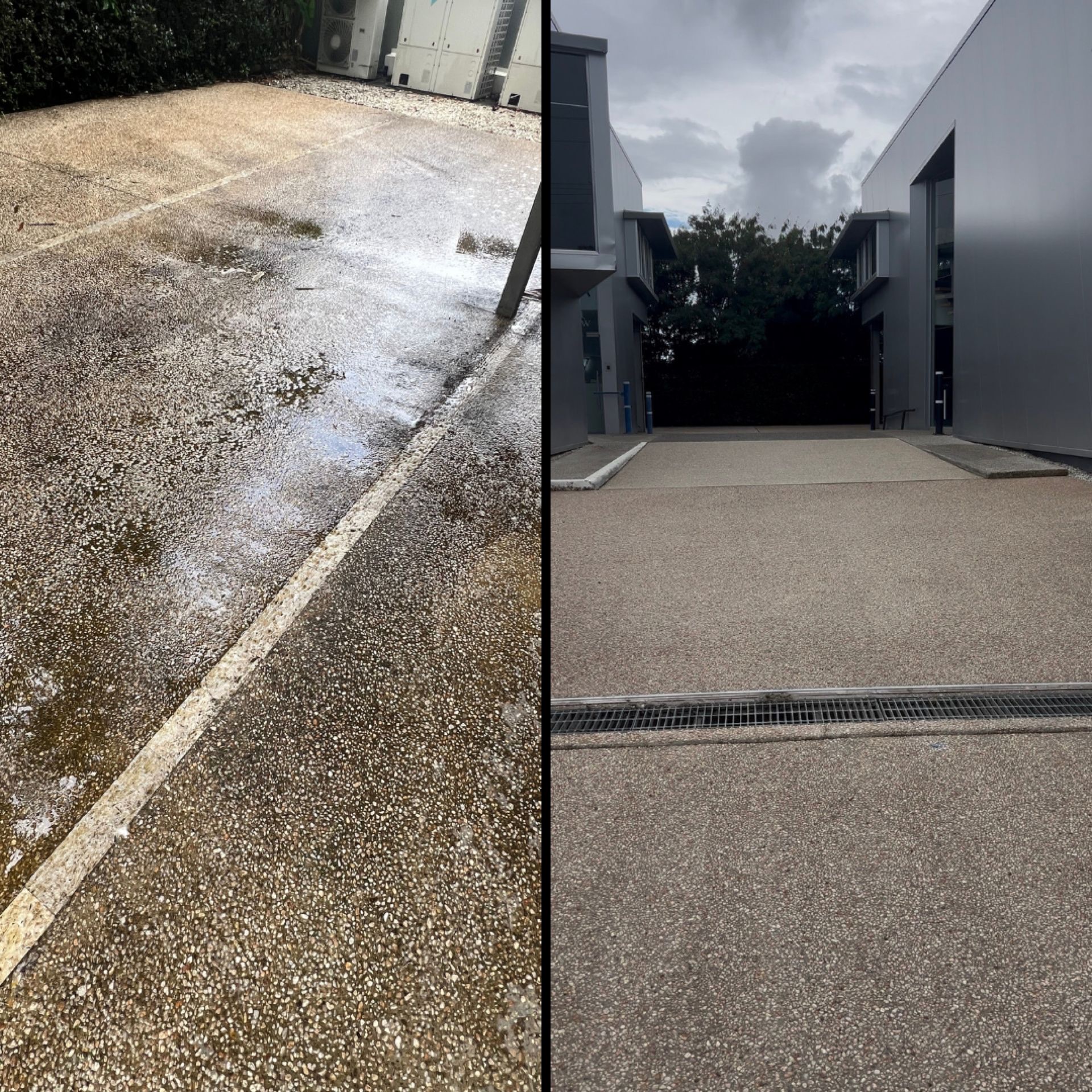

What We Did
Site assessment & weekend scheduling
Walked the site with the practice manager during a weekday consultation to scope the work — approximately 500m² of pebblecrete forecourt and walkway between the two practice buildings. Confirmed weekend scheduling to deliver the clean without disturbing physio appointments, deliveries, or staff during operating hours. Commercial cleaning at this scale typically can't be delivered during business hours without major disruption — weekend or after-hours work is the standard solution.
Slip-hazard assessment
Identified the most heavily contaminated sections — areas where biological growth on pebblecrete had created genuine slip hazards for patients walking between the buildings. Pebblecrete with embedded mould and algae becomes significantly more slippery when wet, which matters specifically for a healthcare practice where patients with mobility issues are walking the surface routinely.
Equipment & PPE setup
Set up the surface cleaner, hoses, and water supply for large-area work. PPE included ear protection (visible in the action shot — surface cleaners run loud at scale), waterproof jacket for sustained wet weather conditions, and safe footwear. Large-area commercial cleaning is genuinely a different operation to residential pressure washing — the equipment runs longer, the noise exposure is higher, and PPE isn't optional.
Surface cleaner pressure wash — full 500m²
Worked the entire 500m² area with a flat-surface pressure cleaner attachment at appropriate pressure for pebblecrete. Surface cleaners with rotating high-pressure heads deliver even, controlled pressure across large areas that hand-wand work alone can't match — both for finish quality and for the time required to complete the job. Overlapping passes ensured no streaking or missed sections across the full area.
Edge & detail hand-wand work
Hand-cleaned the edges, expansion joints, and the transitions between the pebblecrete and surrounding structures with a wand at appropriate pressure. Surface cleaners can't reach edges, so detail work is what makes a 500m² clean look complete rather than obviously machine-cleaned.
Final rinse & site handover
Final rinse to flush all loosened contamination clear of the property. Site left ready for Monday operations with the practice opening to clean, slip-safe surfaces and no evidence of the weekend's work other than the visibly cleaner forecourt.
The Result
Approximately 500m² of commercial pebblecrete cleaned across the weekend without disrupting the physio practice's operating week. Slip hazards reduced significantly, the property's appearance refreshed for patient and staff use, and the work delivered without a single appointment, delivery, or working day affected by the cleaning operation.
Commercial pebblecrete in high-traffic environments typically benefits from a pressure clean every 12–18 months — both for appearance and for ongoing slip-hazard management. Healthcare practices with mobility-impaired patients should consider this part of their facilities maintenance schedule rather than a discretionary cleaning expense.
Suitable For
Large-area commercial cleaning for healthcare, retail, body corporate, and similar properties almost always needs to happen outside business hours to avoid disrupting operations. Operators set up only for residential daytime work aren't equipped for weekend or after-hours commercial delivery — and the clients who need this kind of work need operators who are.
This commercial project covered approximately 500m² of pebblecrete forecourt and walkway between two buildings of a physio practice — large-area surface cleaning scheduled across a weekend to avoid disrupting the practice’s working week. Two specific drivers made this job important: appearance refresh for the property, and slip-hazard reduction for patients walking the surface routinely. Pebblecrete with embedded mould and biological growth becomes significantly more slippery when wet, which matters specifically for a healthcare practice where patients with mobility issues are using the surface every day.
The work itself ran as a standard surface-cleaner pressure wash — a flat-surface pressure cleaner attachment delivering even controlled pressure across the full 500m² area, with hand-wand detail work on edges, expansion joints, and surface transitions. The technical method isn’t dramatically different from a residential driveway clean. What’s different is the scale, the safety overhead, and the scheduling. Commercial cleaning at 500m² runs surface cleaners for hours rather than minutes, requires PPE that residential work doesn’t (ear protection in particular — surface cleaners are loud at scale), and almost always needs to happen outside business hours to avoid disrupting the client’s operations.
The action shot captures the operation in progress: technician in full PPE, surface cleaner in use on the cleaned section, both buildings of the practice visible on either side, and the wet cleaned forecourt extending behind. Weekend delivery meant the practice opened on Monday to a clean, slip-safe site without a single appointment, delivery, or staff working day affected by the cleaning operation. Suitable for healthcare practices, body corporate and strata commercial buildings, office parks, retail strip walkways, and any large pebblecrete or exposed aggregate area where the work needs to happen around the client’s operating schedule rather than during it.
More Like This

Acit Commercial Facility Full External Clean — 3000m² in One Day
Logan
Single-day commercial external cleaning project for Acit ("We Speak Food") — a 3000m² facility cleaned across one working day. Full soft wash and pressure wash of all external walls, breeze block sections, render, soffits, eaves, and roller doors to remove heavy mould and organic contamination. Coordinated team delivery at scale, with the food industry's particular hygiene and presentation standards in mind.
View project →
Balcony Tile Pressure Clean — Gold Coast
Gold Coast
Heavily stained white tile balcony in a Gold Coast residential property restored to clean original finish via pressure cleaning. Tiles, grout lines, glass balustrade, and white framing all returned to a clean, even appearance ready for use.
View project →
Byron Bay Mansion — Synthetic Turf Maintenance Package (6-Monthly)
Byron Bay
Ongoing 6-monthly maintenance package at a luxury Byron Bay mansion — synthetic turf restoration including debris and algae removal, pressure washing, fresh sand topup, and power brooming to maintain the turf in show-condition year-round. Plus surrounding hardscape pressure washing across stone retaining walls and feature elements. The kind of recurring maintenance contract that keeps a high-end property at presentation standard between major restoration cycles.
View project →